
Code Orange
Trying to be helpful here, promise

Journalism used to be called the first draft of history. People might snicker to hear you say that today, but it’s true.
Another quaint old idea about mainstream journalism was that it should serve the public interest. That meant focusing on the most important, relevant information for the widest possible set of people.
The person with the mic at the radio station, in front of the TV camera, or with their fingers on the keyboard had the uncommon power to reach many millions of people, instantly. That power came with responsibility. It helped as well, that the advertising business model that used to support journalism meant there was a core business interest in doing public interest journalism.
It’s been many years since that has stopped being the case, for various technological, economic, political and social reasons I’ll explore another day.
But today I want to do my best attempt at a first draft of history. The events of the last 72 hours deserve to be reflected on in the wider context of the past three decades of world history1.
I’m writing in a way that I hope is easy to understand for the widest possible number of people, with important directions of further thinking I believe everyone would be well-advised to follow.
We are living through tumultuous times in which it sometimes feels like our individual actions matter much less than larger forces at work. I understand that point of view. But for people of at least some means, who are literate, thoughtful and have a soul, it’s an important time to take stock and decide what kind of people we want to be.
Decisions we take now as individuals will have an out-sized impact on how our own lives play out in the years to come, and may also prove important in steering our societies towards better, or at least less bad paths.
The choices we make matter. How we choose to regulate ourselves matters. The moral codes we choose to live by matter. Trying to anticipate future dangers and prepare for them in the best ways we can, to take care of ourselves and our people matters deeply.
Because one grim reality that I would urge more liberal, leftist or typically idealistically-minded readers to consider is that the Israeli-U.S. attack on Iran probably marks the final nail in the coffin of a world in which humans could hold on to any hope of collective, collaborative and ultimately successful overcoming of shared global challenges.
That’s the world optimists could genuinely make the case for at the end of the Cold War. A period around the end of the millennium when a set of global institutions from the UN, to the International Court of Justice, the World Health Organization and the World Trade Organization could be thought to provide the structures necessary for the nations of the world to put aside strategic rivalries to focus on common challenges such as climate change, tackling disease and building prosperity for all, sometimes called “global public goods”.

The final passing of that historical hope has material consequences for everyone. But that doesn’t mean that everything is about to go to hell in a hand-basket overnight. Understanding where the state of world affairs sits on the sliding scale towards a full-on global war can be a critical advantage in each of our decision-making processes for the medium term.
It’s useful to think of the risk of global-scale state-on-state conflict in terms of a color scale, with Green representing the height of peaceful prospects and Red signaling the return of conditions similar to those in which World War 1 and World War 2 broke out. I would suggest that we are currently in a phase-shift from Yellow to Orange. If things get worse, we may see Code Red.
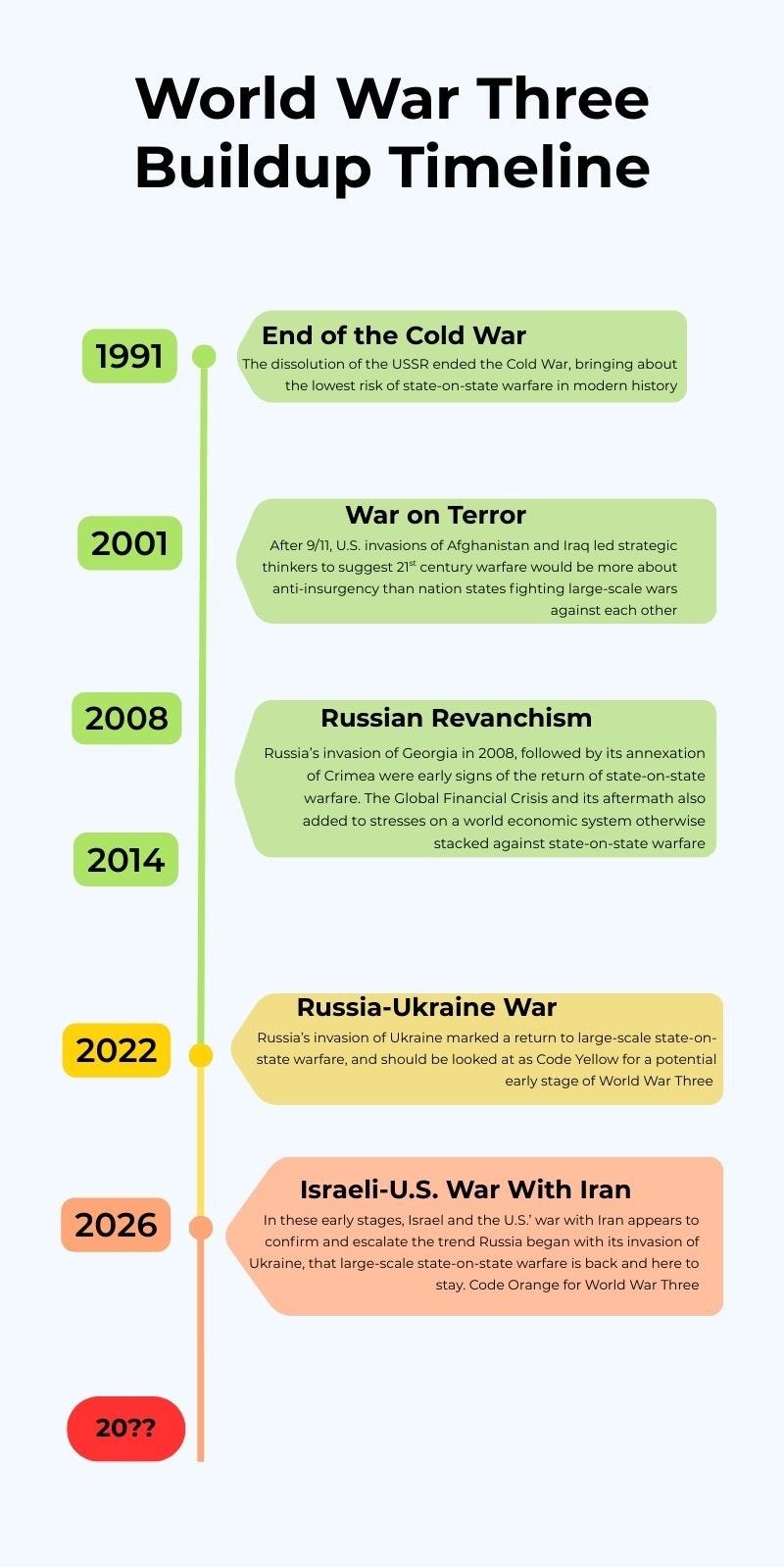
As you can see from the above timeline, the direction of travel is not good. We live in an increasingly dangerous era of state-on-state warfare.
And yet, it doesn’t follow that Nuclear Armageddon is around the corner. The most experienced minds in international relations and great power conflict will tell you that there’s a risk of falling into World War 3, but it remains entirely possible that things stay at “only” Cold War 2.
Even if we are in the early days of what will eventually be looked at as the Third World War, it might not take the shape of the whole-of-society existential conflicts the previous two world wars became. It might play out more like the Seven Years War, a global conflict in the middle of the 18th century that involved fighting between major powers across Europe, North America, the Caribbean, India, and parts of Africa and Asia. Soldiers died, the global balance of power shifted, elite fortunes were made and broken, but life changed less dramatically for most non-combatants.
With that said, even if the current conflagration in the Middle East somehow cools off relatively quickly, I find it hard to see how greater state-on-state conflict is not going to become more common in the new world disorder.
I don’t want to alarm anyone more than required. But when alarming things are happening, it’s prudent to consider what the implications are for each of us. These are a few I would suggest for now:
Place matters, a lot. After the pandemic, many tech-enabled white collar workers started to imagine they could be anywhere in the world, thanks to reliable and lucrative money-making channels they were tapped into online. There are somewhere around 40 million digital nomads in the world today. Rising state-on-state warfare is a big risk to consider for anyone interested in this kind of lifestyle.
Passports are going to be even more important than they already are. Which countries’ passport you hold has for most people in the last three decades been a determinant of fairly quotidian things, like how much you pay in taxes, the quality of roads you’re used to driving on, and whether you have any difficulty getting a visa. National rivalries, such as they existed, tended to remain relatively abstract for most ordinary people. Code Orange means more instances in which your passport determines whether you are evacuated from a warzone or stranded in one, whether you watch the news about distant conflicts or get drafted to fight in one.
A ramped up propaganda war in conjunction with ever more powerful AI spells major challenges for the global information ecosystem. We will each have to be more conscious about our individual information diets, both to ensure we are getting and acting on information that is closer to physical reality, and to defend our mental and emotional well-being. Unlike previous eras of information warfare, it is now easier than ever for us tiny human-beings to self-sabotage with the cheap electronic mass communication tools at our disposal.
If you were worried about what climate breakdown or strange, super-powerful intelligence might entail for your ability to live a reasonably long and fulfilling life, greater state-on-state conflict is of course a bad, bad accelerator of both of those categories of risk.
A world of greater state-on-state conflict has big implications for all of our personal finances. That merits its own separate post, that I plan to write soon.
Till then, take care.
This is also the span of our entire lives so far, for younger millennials like myself!